Review: Hyundai Ioniq 5
posted by Jeff | Friday, July 24, 2026, 7:12 PM | comments: 0All of our car history over the last 12 years has been Tesla, plus two leased Nissan Leaf's (the second of which was totaled in an accident). The Model S was exquisite. I loved that car, but didn't love paying for it. The 3 was solid, and then my Model Y was a rattling mess with poorly aligned body panels, even if it was mechanically sound. Diana's Y (which replaced the totaled 3) was better, but they've since ditched the steering columns stalks for more capacitive buttons. It's not even Elon's politics, given that 65k other Americans work for Tesla, it's that there are more choices, and I was ready for something different. So our seventh EV is an Ioniq 5 in the Limited trim.
Pricing and features
I ended up getting the car for about $41k, then with taxes and dealer fees, it was about $46k all-in. Sticker was $48k, but I used their financing that knocked $7k off, then paid it off two days later. For the first time ever, no new car payment with a new car! $41 isn't a cheap car, but it has all the things except for AWD, which would negatively affect range anyway. The cheapest trim with a smaller battery, after that financing, could be as low as $29k. The car is an extraordinary value. The Model 3 was $51k back in 2018. Diana's Y was $41 just two years ago, but that was with the $7,500 federal tax credit, which is now gone.
The American car makers (aside from Tesla) have largely abandoned mid-tier EV's, aside from the Chevy Bolt and Ford Mach-E. The German makers have some excellent, but pricy options. And the Japanese... I don't understand how they haven't been winning from the start, especially Toyota given the loyal Prius base they had. But the Hyundai group, including Kia (the EV6 is the same platform as the Ioniq 5), is really filling the gap.
The reason I was holding out for the Limited trim was that it has all the things, where the other trims do not. It's an enormous list, starting with no phone key (that was not negotiable), and also no HUD, no sun roof with shade, no rear passenger shades, no premium audio, no ventilated seats, no video rearview, no recliner seat for chilling, lesser or no driver assist features, no ambient lighting, no 360 camera view, no in-dash blind spot cameras on turn signal, no B-pillar air vents for the back seat, no auto sensing wipers, no folding mirrors... and I'm sure I'm forgetting things. Mind you, the Limited trim is $5k more, but it's a huge difference.
Driving
The tech is the cool stuff to me, but I should start with the actual driving experience. It's consistent with most EV's, in that it provides near-instant torque at any speed. It's not as much torque as a Model Y, and you can feel a slight difference, but in practical terms it's a non-issue. The 0-60 is slower, in that the AWD Y I've measured at a consistent 4.6 seconds, whereas the Ioniq is more like 6 (the AWD version is clocked at 4.4). I think Hyundai takes a conservative software approach, because it's a much smoother acceleration curve at the bottom. You'll still leave everyone behind you coming off of a red light, it's just not as punchy as the Y. Again, in normal driving, this doesn't matter. The important thing is that it's super fun to drive.
My Y feels every bump in the road, whereas this the Ioniq feels a little softer. It's a little quieter, too, though over air conditioning I'm not sure it's much different. I think the Ioniq rolls just a little in fast turns, which tracks since its center of gravity is higher than the Tesla. The Ioniq also has a longer wheel base, so in theory it feels more stable, and certainly is smoother.
There are two annoyances though. First, it doesn't retain the driving mode when you power down. So part of my routine has to be to switch it into sport mode every time. That stiffens up the steering a little and makes the acceleration more punchy, which should just be the default for an EV. I think the reason they do this has more to do with hitting efficiency and range targets than anything else, relative to regulatory scrutiny. The other thing is that it has different levels of regenerative braking, controlled by paddles on the steering wheel. It defaults to "level 3," but that's one lower than "I-Pedal," which is true one-pedal driving. You have to set this every time too. Given the benefits to range, I don't understand why this isn't the default. Again, it's partly regulatory, and also the AWD version has to fight against its own front motor in I-Pedal mode because of the way it's designed. That's why the range is lower, too, whereas a Tesla AWD actually has better range.
Fit and finish
The thing that bugged me about the post-Model S Teslas was that the fit and finish was never great. My Y was particularly bad, and if you get behind almost any of them, even the new ones, look at the alignment of the trunk. The gaps won't be equal or it won't be flush with the rest of the body. And ugh, the rattles and squeaks. Diana's was better than mine. But the Ioniq 5 has no such issues new. It makes no noises, and everything outside lines up as expected. Everything feels solid, including the satisfying door closing.
The materials inside don't feel cheap, and they don't look cheap. They use a lot of recycled plastics and nice faux-leather on the seats. The steering wheel might be real leather. There's a fair amount of fabric all over, much of it made from recycled and eco-friendly materials. The screens are very clear and bright. The pedals are even metal (on the Limited trim). It feels more premium than it actually is.
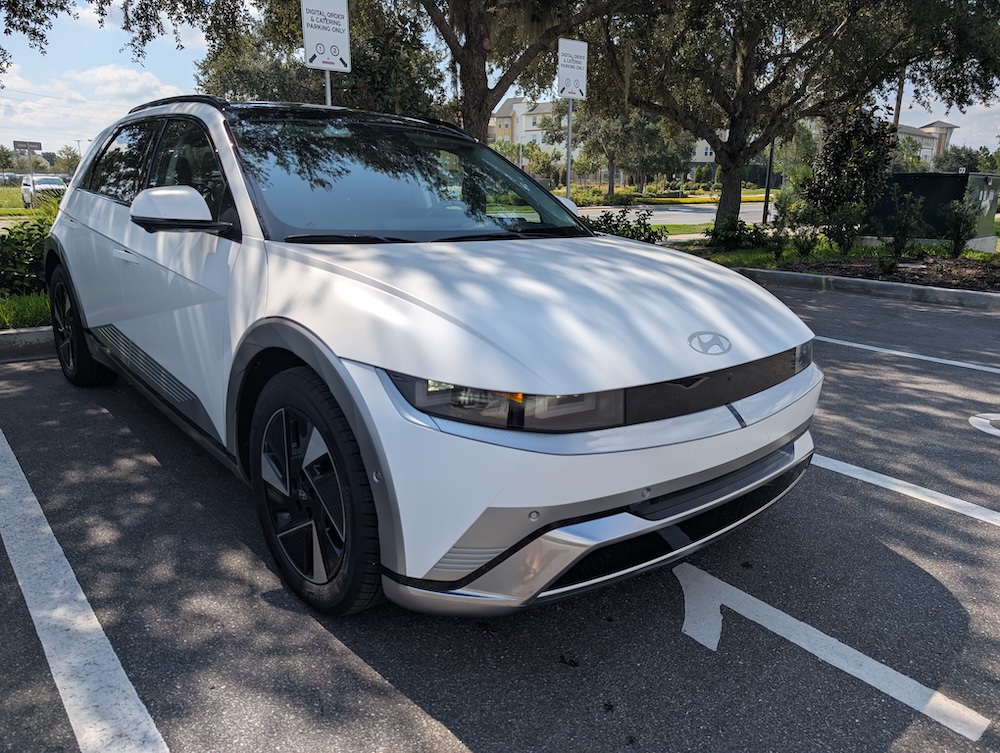
I got one of the matte paint colors, white. I was on the fence about doing matte paint, because it requires different care and chemicals than a regular clear coat. You're not supposed to take it into a car wash with brushes, and you have to avoid any kind of wax or soap with wax. It comes with a Dr. Beasley's matte paint care kit, with special soap and cleaners, and importantly, a ceramic coating. You have to wash it once, then apply the coating on wet panels. Once you've got that, dirt just slides off of it, meaning a simple rinse mostly does the job. So it's a little more work up front, but the results are impressive.
Also, the car just has a ton of personality. It has weird sharp angles and this recurring pixel pattern in all of the lights. The contrasting gray trim is interesting. I think it's a good looking car, and not just another cross-over blob. The inside is comfortable, too, even in the back seat. It has a little less cargo room than a Model Y, but I've still got two of those hanging around if I need the room.
Charging and range
One of my requirements in the car search was that it had to have an NACS port, better known as the "Tesla connector." It's derived from existing standards anyway, so maybe it doesn't entirely matter, but I wanted to have that native to the car, without an adapter. The Ioniq 5 also has NACS, and an 800 V architecture, so it can theoretically charge faster than a Tesla at a charger that's fast enough.
The charging cable it comes with includes a standard wall plug and a NEMA 14-50, which is what we already have in the garage. That means level 2 charging at 240 V at 30 amps, or about 7 kW. That works out to around 28 miles per hour, which is more than fine over night. At newer superchargers, it should do 10 to 80% in about 20 minutes, and some Electrify America chargers can use the full 800 V and do it in 18 minutes. As I've said before, on the rare occasion you need public charging, you're probably stopping for food or potty anyway. This is a non-issue that people make too much of a big deal out of.
The car is rated for a 318 mile range new. As I'm nearing the end run of a full charge, it looks like it'll be close to 340 miles. That makes sense, because so far it's showing 4.1 miles per kWh, and the battery's useable bit is 84 kWh. That's pretty great, with summer AC (and seat ventilation!) running. The Model Y tended to do 3.4 miles, sometimes less, in similar conditions. So with electricity spiking to almost 16 cents per kWh lately (used to be 12 cents), that's solid. And 4 cents per mile is still way lower than 13 cents when gas is $4/gallon and your car does 30mpg.
All the gadgets
Like I said, I held out for a Limited, and it does not disappoint for a gadget geek. Having a phone key was non-negotiable, and only that trim had it. The infotainment and mapping is actually pretty good. There's a charging pad right in the arm rest for your phone, and it supports Android Auto and Apple Carplay. Auto/Carplay is not really that necessary, and the car has a SiriusXM radio. The only gap is a podcast app, so I need my phone for that. The problem with wireless Android Auto though is that the phone gets really hot on the charger, to the extent that it throttles performance. It's a little better if you plug it in, but that's not as convenient. If it just worked without the heat, I'd be fine to use it all of the time, but otherwise, the in-car mapping and audio are fine.
The fancy things are a lot of fun. The heads-up display is impossibly bright, even in bright sun. The ambient lighting is cool at night, especially in blue. The Bose speakers are good, and there's a subwoofer. The 360 camera when parking is neat, and the turn signal cameras are vastly superior to Tesla's, in part because they're in front of you. Ventilated seats are life changing, and essential in Florida summers.
Most importantly, and this was a significant reason to look for something else, is the physical buttons. All of the primary computer functions have a physical button, with volume and tuning knobs. The seat ventilation and heat are on buttons. The HVAC is capacitive buttons, but at least they're not on a screen. The biggest mistake from Tesla is ditching the stalks on the steering column, including the turn signals. That's not a problem here.
The camera screen in the rearview mirror is neat, but not practical because it forces your eyes to refocus. Remember, a mirror allows your eye to focus far away from the car, but a screen that close forces focus that close. If you need glasses in either direction, this breaks that, and even for perfect eyes, the refocus required looking out the windshield to the mirror screen is a lot.
Hyundai's app is not very good either. It does this weird thing where you fire off a command and it sends you a notification. Part of it is not the app, it's the architecture decisions they made, because you don't have a streaming data connection to the car when you have the app open, like you do with Tesla. Under the hood, it sends a command, then every few seconds asks, "Are you done yet? Are you done yet?..." I'm building my own app, and I'll put it up as open source.
Conclusions
Having to reset the driving mode and braking mode every time is annoying. Having a power button, and no automatic walk-away locking is also suboptimal. These are not great quirks. I suppose muscle memory will resolve that eventually. Fortunately, there are a ton of positive quirks that give the car a lot of personality, and I really dig that. All of the tech stuff is not really that necessary, but it's still super cool.
I'll have to follow up later, to see if I'm still infatuated with it then. The initial impression is very strong.
Comments
No comments yet.