Archive: September, 2026
Our attention is totally broken
posted by Jeff | Friday, September 18, 2026, 10:22 PM | comments: 0One of the engineering leaders at work attended a conference where he could see a trend or theme among the speakers and their research. It showed that delivery was not increasing, small iterations in software are down, quality is down relative to defect rates, etc. In other words, it feels like we're all doing more stuff, and what a time to be alive and spend money on AI compute.
We're suddenly boomeranging back to outcomes, I think, and a lot of folks (including me), are asking how it is that we're spending all of this money and not actually getting better results. Meanwhile, the AI bros, if they were ever humans in the first place, have almost entirely disappeared from LinkedIn. No one has told me I'm doing it wrong in like a month! But I still haven't been more excited about making software, and that's after two-plus decades. What's going on?
For better or worse, I think about almost everything in terms of time to delivery. I built my reputation at my last job as leading the team that delivered fast at the highest quality possible, and had the stats to back it up. We did this by ruthlessly cutting scope, validating the work against real usage, and continuous iteration. That's not exactly innovative, and I didn't invent any of that. If it gets in the way, ask if it's even worth having around. That goes for process especially. Got something greenfield to build? What's stopping you from getting some minimal thing out in two weeks or less?
Toward the end, when we had access to agentic coding, the coding part got faster. Delivery got a little faster, but what I observed was that we spent more time deliberating and debating stuff, while using more time to reduce tech debt. AI wasn't making us that much faster, but it was making our outcomes, and software, better.
That, in my opinion, is the problem. AI bros had everyone obsessing over one-shot, throw-it-over-the-wall development, as if the machines without wisdom and judgment were going to get there faster. But remember when you trusted that one alpha-dev to go off and build something? When he came back with the thing, it was never the right thing. Many of the assumptions about requirements were wrong once you got them in front of real users. Why did anyone think that the you'd get a different outcome with the robots?
Agentic coding has given us the gift of time, and we're squandering it by giving away our attention. We're obsessed with things that have nothing to do with delivery, and worse, do not improve quality. Our attention could be directed at figuring out how to make software better, in a world where frankly most of it sucks. Instead, attention is spent on token usage and parallelization of work. There is little evidence that suggests this makes software better.
Let's fix our attention.
New router who dis
posted by Jeff | Monday, September 14, 2026, 5:30 PM | comments: 0I replaced a trio of TP-Link Deco mesh routers/access points from almost five years ago with a pair of Asus units. It's weird, wifi is still evolving after all of this time. As it turns out, three was overkill, because I can put two in opposite ends of the house, connected by ethernet, and the whole thing is covered.
There were a few motivating factors. First, the Decos have really crappy logging. I got interested in logging when Spectrum started sucking a few weeks ago, with random, but brief-ish dropouts in the evening. The Asus logs are a little more verbose, and I can feed them into a robot for detailed event analysis if I have to call support. Also, it's possible I might be able to get bidirectional gigabit speed if I get the right person at Spectrum on the phone. There has always been fiber to our house, but they use RFoG (radio frequency over glass) for reasons unknown to me. In new construction, there's little reason to do that. Anyway, the old routers can't quite go that fast if we do get real fiber.
Infrastructure stuff is the most boring electronic gear. I mean, unless you nerd hard on that sort of thing, and I have friends that do. I'm surprised at how many routers I've had. I have one that's about 11-years-old that I need to recycle. It's not secure at all because of the older protocols it uses.
Do you tell your employer that you have autism?
posted by Jeff | Friday, September 11, 2026, 9:46 AM | comments: 0It's an interesting time for people in middle age, and to an extent, Millennials getting closer to that time. A lot of us have gone through the gauntlet of an autism diagnosis, often motivated by seeing our children navigate one. I got mine about five years ago, and I kind of knew. Watching my kid grow up was like seeing a movie that I was in. For me, along with an ADHD diagnosis, it gave me permission to look at my entire life with fresh eyes, and give myself a little grace for things I once saw as personality flaws.
I was between jobs at the time, but I wondered if I should bring it up in organically in interviews, or if I should tell my new employer. It's a somewhat personal and private thing, and it brings up a ton of legal issues. But three months after that diagnosis, I told my new boss. I explained to him that, as best I could tell, I sometimes have blind spots, and don't always read a room correctly. It's even harder working remotely. My motivation to ask questions isn't to challenge authority necessarily, but because curiosity makes me want more context.
Years later, I asked him if he treated me differently, and he said, "Not really, I was just looking for reasons to put up guardrails, but you didn't need them." That tracked for me, and what it really bought me was the freedom to have great discussions about my leadership. It also confirmed what I had understood about management for a long time... the job is enablement and outcomes, not telling people what to do.
Is this the right thing for you? It depends a lot on experience, I think. I try to look at autism as an explanation for certain aspects of my personality, not an excuse. This may annoy some folks in advocacy circles, because they focus on how many of us need to work harder to conform to certain expectations ("masking," as it's often described), and should get a pass for that. I get that, but neurotypical folks are also emotional humans that are not exactly naturals at social contracts. My opinion is that being wired differently isn't hard because of the wiring, it's hard because it's misunderstood. To me, that's all the more reason to talk about it.
But those of us who are "late bloomers" also have the benefit of years, maybe decades, of experience building coping skills to account for things that are harder. What a strange thing that it's a huge benefit now, but the lack of understanding was suboptimal growing up. What I see now with my son is that accommodation is vastly favored over accountability, and I don't think that's serving him in the long run. There's no incentive to learn about how your differences affect you and others, negatively or positively.
Whether or not you choose to reveal your diagnosis is up to you, but I think you need a deep understanding about it first. There are so many issues of identity, self-care, relationships that go along with it. What you shouldn't do is declare, "Look at me, I have this thing, now accommodate me!" As a spectrum disorder (and I sure hate the "disorder" part, something I hope the next DSM fixes), as we know, some people need support to live, some are billionaire tycoons, and there's a lot of room in between. Knowing where you are, and being able to articulate that, helps folks "get" you.
Tennis is the sportsball I appreciate
posted by Jeff | Tuesday, September 8, 2026, 8:47 PM | comments: 0It's no secret that I'm a volleyball junkie, especially during the Olympics. I've been around it most of my life. When I met Diana, she was playing USTA tennis, and one of our earlier trips together was to see the Cincinnati tournament. For the brief time we were back in Cleveland, we both joined the tennis club two freeway exits down. I took lessons and played a season myself. I really got into it. I'd love to play again, but it's too damn hot here for that, and for some reason the clubs don't have indoor facilities.
I don't have much in the way of technical expertise, because I just haven't played enough or had enough in the way of lessons. Still, I really love watching it on TV. The US Open in particular is something that we routinely watch, in no small part because it's in our time zone. (Wimbledon we rarely catch more than the semis and finals.) ESPN covers most of the big matches from the start, and these days you can subscribe via Sling for $20 for one month. Totally worth it, because we tend to watch a ton.
This year has been extraordinary, because there have been upsets and comebacks and it has been completely unpredictable. Tonight we saw a match going four and a half hours between Americans Tiafoe and Michelsen in the quarterfinals. Michelsen wasn't even ranked, and he won the first two sets, and served for match point in the third. Tiafoe went on to win that set, and then won in the fifth set tie break. I don't know what the odds are to come back like that, but they've gotta be very small.
I'm looking forward to the finals this weekend. It's been a great tournament so far.
Carpet trash
posted by Jeff | Monday, September 7, 2026, 8:50 PM | comments: 1When we first moved into our house, I felt pretty excited about it. As a regular remote working person, I couldn't wait to have more room. Diana was pretty avidly quilting, and having a room big enough for that was awesome. And we had a ton of room for entertaining. We probably don't have people over enough, but when we do, it doesn't feel crowded. For the first time, I felt good about where I lived, like we could be there for a good while.
Nine years later, I'm frustrated with how cheap the builder, Pulte, was. We had to paint the exterior after just four years (looks good as new in the five years since). The primary shower started leaking after three years. We had to replace one of the HVAC systems at seven years, and that's after repairing it periodically since the start. I imagine the roof will be a problem next year.
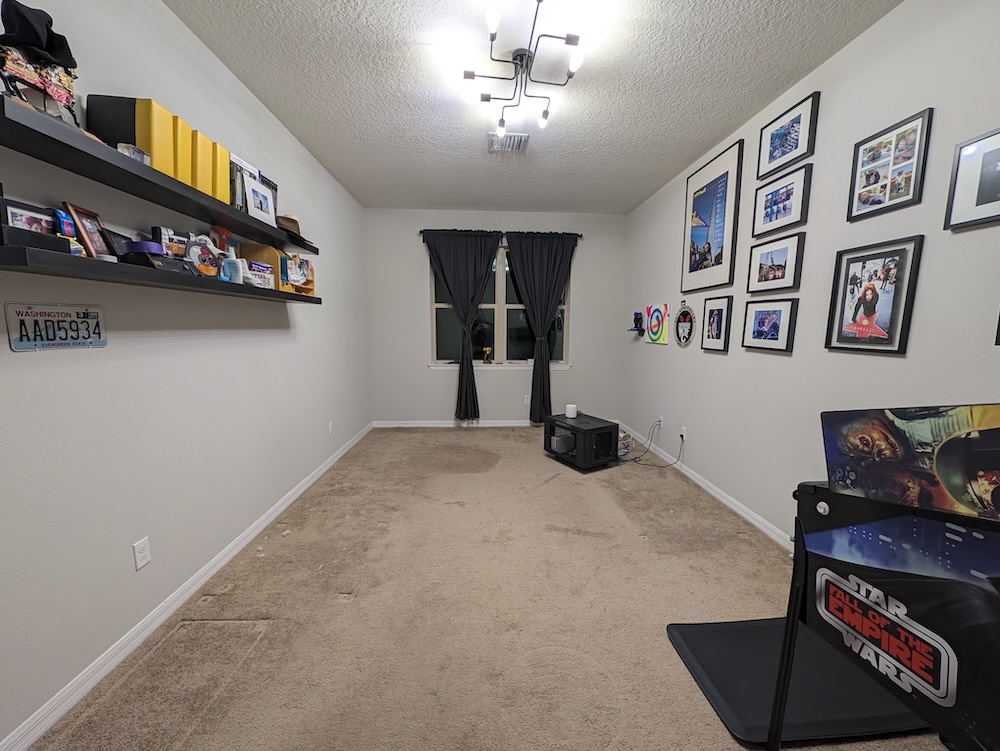
But the daily reminder of the cheapness is the carpet. They didn't even have an option to upgrade it. So by the third year, it looked like a dozen people lived here for 20 years. It wrinkles up in every room, and no amount of vacuuming ever made it look fresh. It just looks and feels terrible. So as soon as I started working again, I wanted to pull the trigger to at least replace the carpet in the two downstairs rooms, my office and the front room. And I went with the thickest possible pad and the highest pile. If I'm gonna spend 40 hours a week in that room, it's gonna be the best. And when it's just two rooms, at least it's not the worst expense.
So tonight, everything is disturbed. We had to empty those two rooms. My office in particular is challenging because my desk weighs like 200 pounds (it's a large, L-shaped standing desk). That's also where the pinball machine is, a heavy ass file cabinet (full of stuff I need to toss) and my big chair and love seat. Like I said, I spend 40 hours in there, I want it to be comfortable. Everything is out now, and there's so much room for activities.
Tomorrow, it'll feel like new again.
When will it be OK to enjoy winning?
posted by Jeff | Wednesday, September 2, 2026, 7:36 PM | comments: 0This is, in some ways, a continuation of my previous post, about finding meaning and fulfillment from winning. Pulling off perfect service in hospitality, or putting on a great show, these are definitely time-boxed things that feel like winning when they're over. I remember feeling this with community theater, or when we would do remote shoots with my TV job right after college. Then there was literally winning in any kind of athletic contest, especially as a coach. It was so satisfying.
Outside of putting on a show or crushing a volleyball, that satisfaction, that feeling of winning seems harder to come by. Yes, in the moment, there are big feelings and adrenaline, I get that. But there should also be lingering satisfaction for winning. Why don't I feel that? Some of it is the challenges still ahead, which we're definitely feeling in my house right now. But big picture, fuck, I've got a lot of wins under my belt.
This is just another aspect of the struggle required to live in the moment, I suppose. It's so hard not to focus on that next milestone, getting beyond that challenging time. I have so much to be happy about. The career milestones, a great relationship, and sometimes even a parenting win. I should be celebrating more.
Perhaps this upcoming long weekend will be right for celebrating.
Restaurants are logically terrible, but...
posted by Jeff | Wednesday, September 2, 2026, 5:04 PM | comments: 0We've been watching a few of those "failing restaurant" shows on Max. They're entertaining, to say the least. I especially like the one called Kitchen Undercover (the Antonia Lofaso version), which doesn't really manufacture drama because it's already there. And of course, I just finished The Bear, so that's fresh in my mind, too. The overall takeaway, and reality, is that restaurants are a horrible business.
But I love the idea of showing people a good time. Like most things in hospitality, success comes from excellence, done in a repeatable, fiscally responsible way. It doesn't seem like a mystery that treating people well and providing the best possible product is key, but I'm surprised at how often I encounter the opposite at restaurants, hotels and theme parks.
The scope of my ambition is not large. I can imagine a long, narrow spot, with a long bar and small kitchen. Coffee and pastries in the morning, drinks and small plates at night, vibe all day. I'm sure there's a specific concept I would gravitate to (pirate-tiki bar?), but who knows. The location would have to be perfect, preferably in a neighborhood where you could attract regulars. I would want a qualified manager to run it, but help out when I felt like it. At the same time, I wouldn't want to put a lot of my own money into it, because that's a bad idea. I just want to see people having a good time together.
I also imagine that there could be an even lower risk scheme. A so-called "dry hire" business would be a blast, I think, especially if you did mixology presentations. Those are situations where the host buys all of the liquor, and you show up with your tools to serve it. You have some "inventory" to keep in terms of serving gear and glasses, and probably bring the ice, but you're not putting significant cash into it. That would be a fun gig.
It's strange how I've gravitated toward this sort of thing, if you don't count living in a place that depends on hospitality for its economy. But I think I've always thought about it, just in terms of the arts, or going back far enough, to working in radio. Entertainment is all about making people happy. Turns out there are other ways to do that, too. I have to think more about this.
Olivia Rodrigo is using her power for good
posted by Jeff | Tuesday, September 1, 2026, 5:00 PM | comments: 0Shirley Manson, from Garbage, said in an interview back in 2018, "How bland youth culture has gotten; is it going to be down to the 50-year-olds to do something naughty?" She was about 52 then, and even though I'm younger than her by a bit, this quote still sticks with me. If there's one thing I can say about Gen-X, it's that our youth brought back some of that rebellious energy that predated us by a few decades. It made people older than us uncomfortable, and I loved it. Youth culture has seemed a bit self-absorbed and boring since.
Along comes Olivia Rodrigo, which I often refer to as the 23-year-old Gen-Xer, given her taste in music. She toured with older bands like The Breeders, and newer bands like Wolf Alice, and made her way onto alt rock radio. An entirely new audience is being turned on to something better than the average pop stuff. She might have been another child star Disney brat, but instead has managed to navigate fame and attention in a fairly mature way (in public, at least). She's already three albums in, and learned from Taylor Swift to own her master recordings from the start.
On top of that, Rodrigo is using her voice to callout the bizarre anti-woman behavior and policy that is stripping women of their rights. She just pulled off the Daisy Chain Fields festival last weekend, that managed to raise $20 million for women's charities. She was joined on stage by "our" artists, like Alanis, Sarah McLachlan, and Stevie Nicks (who arguably belongs to the Boomers). Garbage even played the show. Most importantly, I think she's getting an entire generation of young people out of that "blandness" that Shirley talked about years ago. That's excellent.
Oh, Olivia Rodrigo's most recent album is also pretty good. No throw-away songs on it at all.
Art can be so powerful. It makes me hopeful to see someone barely more than half my age using that power for good.